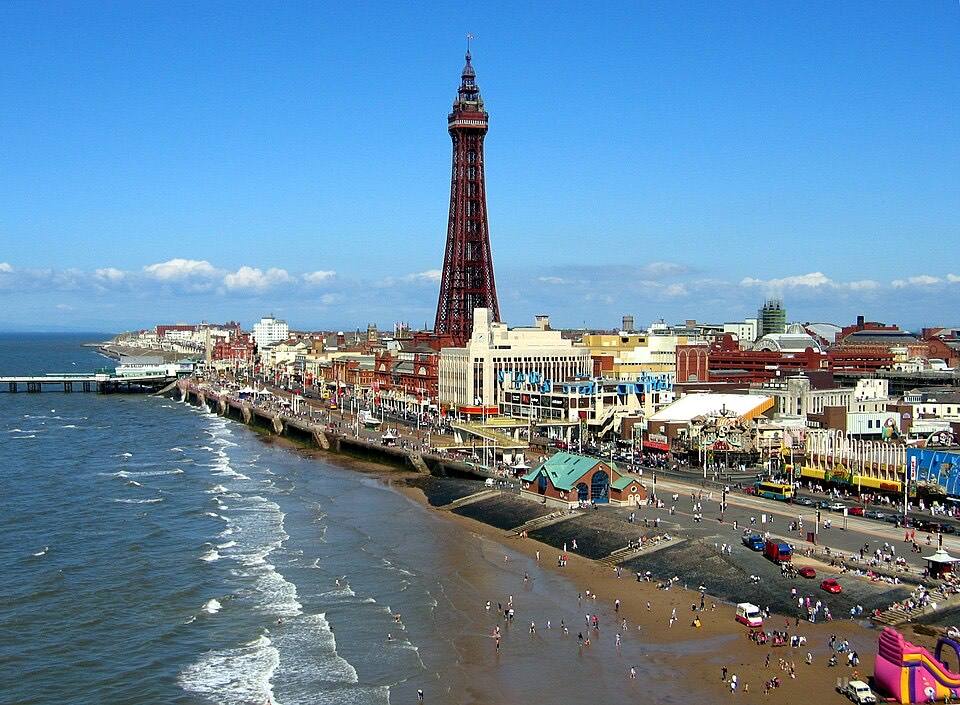

Blackpool is a seaside resort with a tower, a tram and seven miles of promenade. Tredegar is an iron town at the top of a Welsh valley, 228km away, where Aneurin Bevan learned the politics that built the NHS. The data cannot tell them apart.
Median sale price: £142,500 against £137,500. Recorded offences per 1,000 residents: 188 against 157, both deep in the highest fifth of towns. Median age: 44.0 against 43.6. Households owning their home: 58.5% against 60.2%. Gigabit availability: 91% against 91%. Professional occupations: 34.0% against 32.7%. Two towns with nothing in common except every number that describes how their people live.
That pairing comes from this site's "towns like this one" tables: 773 English and Welsh towns of 10,000+ residents, each matched to its nearest neighbours across six rank-normalised measures, with geography deliberately excluded. Most towns' matches are unsurprising. The surprises are the point of this article.
The pair that lives 338km apart
Exeter and Colchester form the closest pair in the dataset separated by more than 300km: cathedral city and garrison city, £295,000 against £300,000, medians of 35.1 and 35.9 years, universities pulling both age profiles down, owner-occupation within one point. They sit 338km apart and live the same life. St Austell and Harwich stretch the same trick to 465km, matching to a tenth of a percent on occupations.
The suburb that repeats across England
The closest twins of all are Bramhall, south of Manchester, and Knowle, south-east of Birmingham: near-identical on all six measures, down to gigabit availability separated by 0.2 points. The affluent conurbation-edge suburb is, statistically, one town that happens to exist in several places.
The same family produces the dataset's cleanest experiment. Wilmslow and Amersham match on age, tenure, occupations, crime and broadband to within a hair. Their median sale prices are £475,000 and £760,000. Amersham sits at the end of the Metropolitan line, 40 minutes from central London; Wilmslow serves Manchester. With everything else held equal by the pairing, the £285,000 gap is about as clean a picture of what proximity to London costs as the open data can draw.
Across the border
Ten of the mutual pairs cross the England–Wales border. Mexborough, a Dearne Valley pit town, and Holyhead, a ferry port at the far corner of Anglesey, share a median sale price to the pound: £150,000. Cardiff's closest English match is York, which will offend both. And Llanelli pairs with Colne in Pennine Lancashire: tinplate and cotton, two post-industrial towns that took the same numbers into the 2020s by entirely different routes.
The towns with no twin
Run the match for every town and some come back nearly alone. The loneliest is Treharris, a terraced village above the Taff Bargoed too small for most comparisons, and half a step behind it comes Durham: a cathedral city with a world-class university, student-driven ages and northern prices, a combination that exists exactly once. Durham's nearest match sits nearly five times further away in the data than Tredegar sits from Blackpool, and it is Chester. Lewes is next, and its least-bad match is Monmouth, across the border. Luton, Bridlington and Skegness fill out the list: even the faded-coast towns, a recognisable family, are odd in their own individual ways.
What this is for
House-hunters use the geographic tables every property site carries: the towns next door. The twins answer a different question: if you can work from anywhere, where else is the town you already like? Someone priced out of Amersham has been told, by the data rather than an agent, to look at Wilmslow. Someone who loves Dawlish's numbers has a twin in Walton-on-the-Naze, 354km away, within 8% on price.
Figures are from the September 2026 build: prices are the latest 12 months of Land Registry sales, crime the latest published year per 1,000 residents (2021 census), tenure and age from Census 2021, broadband from Ofcom, occupations from Census 2021 — each town's own page carries its current numbers and full sources. 193 of the 773 towns form mutual pairs, where each is the other's closest match; every pairing named here is mutual. The matching method, and its refusal to produce a similarity score, is described on any town page's "towns like this one" table.