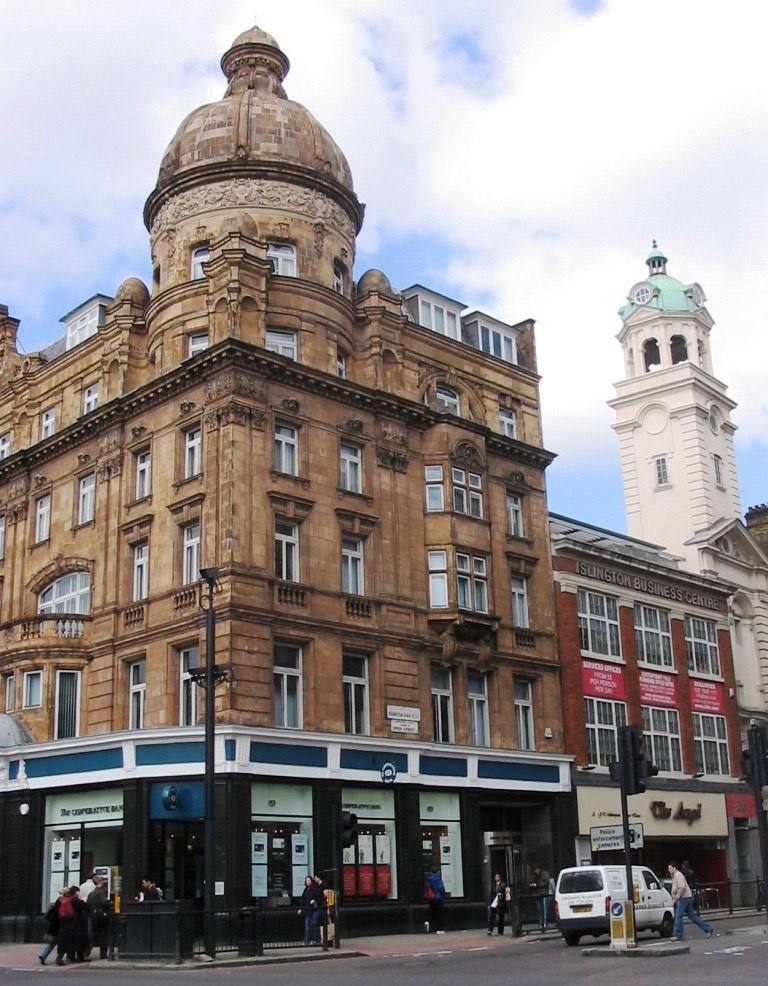
Greater London · England
Islington population
319,143people · latest estimate

Islington has a population of 319,143, making it the 3rd largest place in Greater London.
Year-by-year official estimates for the wider area: Islington population trends, 2001–2024.
Islington in context

Distances are straight-line from the settlement's recorded coordinates. The 10 km figure sums the recorded places within that radius, so it describes how built-up the surroundings are rather than people per square kilometre.
The centre of Islington sits in postcode district N1.
Food and drink on the high street
| Registered premises | Count |
|---|---|
| Restaurants and cafés | 967 |
| Takeaways and sandwich shops | 246 |
| Pubs, bars and nightclubs | 222 |
| Hotels, B&Bs and guest houses | 24 |
| Supermarkets and hypermarkets | 62 |
Counts are registered food premises in the Islington built-up area, from the FSA food hygiene register, extracted 17 August 2026. The boundary is drawn from where the buildings are, so these figures cover the town itself rather than the wider council area, and no total is shown because the register also lists premises nobody would call a venue: school kitchens, care homes, warehouses. Compare towns →
Shops and services
| Premises | Count |
|---|---|
| Shops (all retail) | 2,679 |
| Cafés | 184 |
| Hairdressing salons | 56 |
| Banks and building societies | 23 |
| Post offices | 3 |
| Gyms | 35 |
| Leisure and sports centres | 25 |
| Surgeries (GP, dental and similar) | 70 |
| Libraries | 13 |
| Community centres | 121 |
| Cinemas | 5 |
| Theatres | 7 |
| Car parks | 12 |
| Amusement arcades | 2 |
| Licensed betting shops | 25 |
| Adult gaming centres | 4 |
Shops, cafés, salons, banks, post offices and arcades are rateable premises by use on the VOA 2023 rating list — the shops figure is all general retail, charity shops included. Gambling premises come from the Gambling Commission's licensing register, which lists 6,251 betting shops nationally against the rating list's 3,838: many betting shops are rated as ordinary shops, so the licensing register is the truer count and the one used here. Categories the rating list counts badly are deliberately absent rather than wrong: petrol stations disappear into supermarket ratings, vets and museums run far under their professional registers, and pools and nurseries mostly rate inside other premises. Same built-up-area boundary as the download table on this page.
House prices
| Property type | Median sale price |
|---|---|
| Semi-detached (29 sales) | £2,200,000 |
| Terraced (254 sales) | £1,460,000 |
| Flat or maisonette (1,224 sales) | £575,000 |
| All types (1,515 sales) | £645,000 |
| Change on the year before each type compared with itself, July 2024 to June 2025 | -0.4% |
Medians of actual registered sales in the Islington built-up area, July 2025 to June 2026, from HM Land Registry Price Paid data (standard open-market sales only; repossessions, part-value transfers and non-residential records excluded). A median is the middle sale, so it resists the mansion problem that skews averages. Recent sales take weeks to register, which is why the window ends before the current month. Types with fewer than 20 sales are not shown. The year-on-year change compares this window with the twelve months before it, July 2024 to June 2025, and compares each property type with itself before combining them on this year's mix. Doing it the obvious way instead, median against median, would have this town's prices swing on which kind of house happened to sell: one town in this data sold 29 detached houses one year and 9 the next, and its raw median halved without a single house changing price. The change is published only where the types compared cover most of the year's sales and the town saw 50+ of them. Compare towns →
Council tax
The area Band D council tax for Islington, the billing authority covering Islington, is £2,108 for 2026–27.
From MHCLG's council tax statistics (Table 9): the area average including police, fire and parish precepts, so it is the council's figure rather than the town's, and your own band depends on your property's 1991 valuation.
Schools
| Open establishments | Schools | Places | Pupils | Filled |
|---|---|---|---|---|
| Primary schools | 40 | 14,879 | 12,545 | 84.3% |
| Secondary schools | 9 | 8,435 | 6,490 | 76.9% |
| All-through schools | 1 | 1,360 | 1,561 | 114.8% |
| Sixth forms and 16+ colleges | 1 | — | — | — |
| Local-authority nursery schools | 3 | — | — | — |
| Special schools | 6 | — | — | — |
| Independent schools | 6 | — | — | — |
The 2021 census counted 9,978 children aged 5 to 9 in the town: one state primary school for every 249 of them.
Open schools registered in the Islington built-up area, from the Department for Education's Get Information about Schools register, extracted 24 August 2026. Each school counts once: an independent special school appears under special schools, and the phase rows are state schools. Places are reported capacity and pupils each school's latest census return, summed only over schools reporting both, and shown only where at least 9 in 10 of a phase's schools do; state primaries across measured towns run at 89.2% of capacity, secondaries 91.3%. The children-per-school figure pairs a 2021 census count with today's register, so growth or decline since the census is not in it. No inspection grades are shown because Ofsted stopped issuing single-word overall judgements in 2024 and the register no longer carries them; current inspection reports are on Ofsted's own site. England only: the register lists Welsh schools without phase detail.
Care quality, as the regulator rates it
GP practices in the built-up area with a CQC overall rating: 30 Good, 1 Requires improvement.
Care homes: 1 Outstanding, 14 Good.
Registered dental practices: 54. A count, not a judgment: CQC inspects dentists but does not rate them, so no dental practice anywhere has a rating to show.
These are the Care Quality Commission's own latest overall judgments (September 2026 publication), counted on this built-up area, never combined into any score of ours. A rating's age varies with when CQC last inspected, and unrated locations (new registrations, or types CQC does not rate) are not shown. The dental figure counts every registered location on CQC's directory, NHS and private alike; it says nothing about whether one is taking NHS patients. England only. Compare towns →
Broadband
| Availability | % of homes |
|---|---|
| Gigabit-capable (1,000 Mbit/s+) | 95.0% |
| Superfast (30 Mbit/s+) | 98.4% |
| Unable to get 10 Mbit/s download | 5 homes (0.0%) |
Share of the 108,040 residential premises in this built-up area that the fixed network can serve at each speed, from Ofcom's Connected Nations coverage data (network state July 2025). Availability is what the line to a home can deliver if ordered, not what households actually subscribe to, and a full-fibre street where everyone bought the cheapest package shows 100% here. Percentile compares towns of 10,000+ residents. Compare towns →
Common questions
What is the population of Islington?
Go deeper
Towns like Islington
The closest statistical matches among English and Welsh towns of 10,000+ residents, with geography playing no part. Islington's own figures sit in the first row for comparison.
| Town | County | Median price | Offences /1,000 | Median age | Owner-occupied |
|---|---|---|---|---|---|
| Islington | Greater London | £645,000 | — | 33.5 | 28.4% |
| Cambridge | Cambridgeshire | £480,000 | 109.6 | 31.9 | 45.7% |
| Bristol | City of Bristol | £360,000 | 157.5 | 33.9 | 54.3% |
| Watford | Hertfordshire | £435,000 | 108.2 | 37.4 | 58.2% |
| Welwyn Garden City | Hertfordshire | £415,000 | 97.6 | 39.6 | 57.1% |
| Reading | Reading | £353,000 | 107.7 | 35.7 | 56.1% |
Matched on up to six measures — house prices, recorded crime, median age, owner-occupation, gigabit availability and professional occupations — each rank-normalised across the 773 towns that carry at least four of them. The likeness is mechanical, and the columns are here so you can judge it yourself.